Just Another Book Club- September Book

Please leave your comments below or within the appropriate post on my Facebook page. Please feel free to peruse other people’s comments and respond to them.

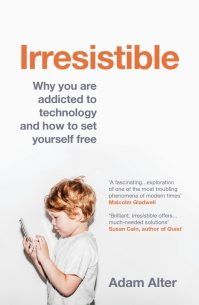
Irresistible: why you are addicted to technology and how you can set yourself free

by Adam Alter
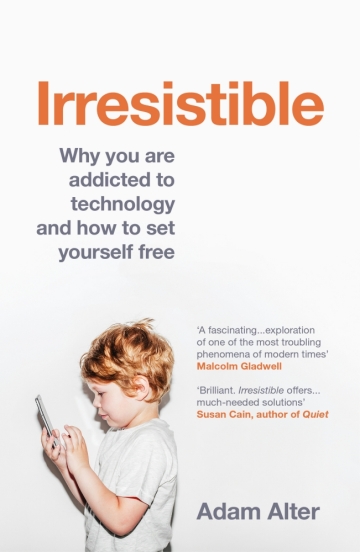
cover

Synopsis

Irresistible is written by psychologist Adam Alter about how society is becoming addicted to our smartphones, laptops, game consoles and television. In other words time in front of a screen is becoming all consuming for most of us. Adam Atler explores how this affects our everyday life, relationships and mental well being. Towards the end of the book, Atler suggests ways we can use technology differently and how it will lead us to living happier lives.

My Quick Review

Well, this is a book I was in urgent need to read. I am as guilty as the next person of spending too much time on my phone, endlessly checking one social media site and then swiftly onto the next. I would say 80% of my smartphone use is probably completely unnecessary. The amount of productivity I could achieve instead of perusing the Instagram photos of a friend of a friend of friend’s account and LOLling at cute cat videos is beyond ridiculous (though I’m still not convinced cat videos are a complete waste of time). So, I thought this book would be perfect for me to read and digest. By the reaction I got when I first published the list of books we were going to read this year, it seems many of you out there were in need of this book too.

I found this book fascinating and very informative. I learnt a lot about addiction. For me, this book completely dispelled the myth that certain people have “addictive personalities” and it’s only these people that become addicted. It was also very interesting how the way game designers engineer their games, deliberately fosters behavioural addiction.

One small negative that I found with this book was that, I’m not sure how necessary or helpful some of the diagrams in the book were. I’m not convinced that I really needed a breakdown of the number of books that contain the word “perfectionism”. Just the fact that it’s increased over the years would have sufficed.

Alter, covered most aspects of screen time addiction, but I do feel it slightly lacked when it came to discussing people who just aimlessly peruse the internet without any interaction. Adler does provides a very good explanation on the gambling side of technology (referring to both actual gambling and the gambling high people obtain from “likes” on social media).

I also felt it would’ve been useful to have a short, accessible list of his suggestions for reducing technology use at the end of the book. Instead if you want that information again, you would have to read through the final chapter again.

The book did a good job of fairly representing the positive aspects of technology. I don’t feel the book could be accused of presenting a one-sided arguement.

As I said before the book was very interesting and I couldn’t put it down (making the book “irresistible”- boom!), but felt the title was slightly misleading. Whilst there were some suggestions, I didn’t really feel it was a book one read to enable the reduction of technology usage. Though it did provide excellent and detailed information regarding addiction and why technology is so addictive.

Overall, this is an excellent & fascinating book. However, I don’t appear to have reduced my screen time. Maybe I need to reread that final chapter?

Questions to Consider

  1. Did you learn anything new about addiction from reading this book?
  2. Since reading this book has it changed your attitude towards technology?
  3. Have you reduced the amount of time in front of a screen?
  4. Do you think the book explained the influence of the internet on society in enough detail?
  5. After reading this book, what are your views on society’s future with regards to technology and it’s influence?
  6. What do you feel was the overall purpose of this book?
  7. Do you feel this book succeeded with its purpose?
  8. What section/paragraph/sentence left a lasting impression on you, if any?
  9. Do you feel the writing style of the author was accessible?
  10. Has this book inspired you to read more books on a similar subject matter?

(Questions created by me)

You don’t have to answer these questions in your comments, but they might help to get you thinking about the book or to prompt a discourse.

October’s book is A Million Little Pieces by James Fey. I’ll be starting the conversation for this on Monday 6th November.

For a list of all the other books we’ll be reading this year, please click here.
Just Another Book Club- August Book

Please leave your comments below or within the appropriate post on my Facebook page. Please feel free to peruse other people’s comments and respond to them.

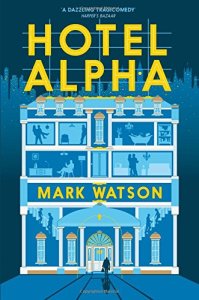
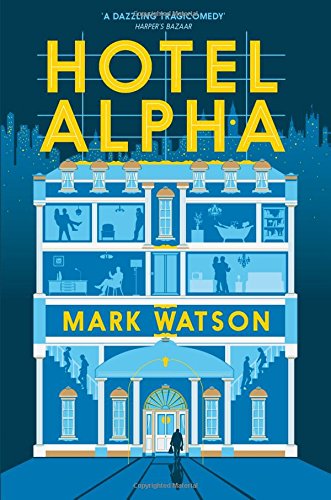
Hotel Alpha by Mark Watson

51wYJqtbPKL

Synopsis

Set in a high class London hotel over several decades, this book is told from two different viewpoints. Graham, a loyal, hardworking and traditional concierge and Chas, the hotel owner’s blind adopted son. Both characters have an idolised opinion of Howard, the charismatic owner of Hotel Alpha. But, is everything as it seems at the Hotel Alpha and is Howard everything people believe him to be?

Written by British stand-up comedian Mark Watson, the book also contains short stories at the end of the book and online about smaller characters from the main story,

My Quick Review

To my surprise, I thoroughly enjoyed this book. I’m not sure why I would be so surprised, maybe because it didn’t “grab me” within the first few pages, but I soon found myself turning the pages quite quickly and wanting to learn more about the hotel and the characters within.

I liked Mark Watson’s focus on his characters. This was a book that was both character and storyline led. I do feel the former was slightly stronger than the latter though. Whilst I was gripped by this book and desperate to find out the hotel’s secrets, I couldn’t help, but feel slightly disappointed when I found out these secrets. I had felt that I knew them already and that there wasn’t a shocking “big reveal”. The only true secret that was revealed, was that Lara and Ella were in a relationship, which really wasn’t much of a juicy secret for me. It smacked of “and guess what, she was GAY” shock horror! It was a weak big reveal.

There was also quite a big unanswered question (unless I missed it) with regards to Graham’s future. Was he intending to just leave Pattie at the end? He said he was going off to find Agatha, but never said what was going to happened to his relationship with Pattie? Was he going to leave her, then look for Agatha? Was he going to find Agatha first, then decide if he wanted to leave Pattie? Shouldn’t he have left her a long time ago as the author made it so patently clear that he was unhappy with her? Was Graham after all not-so-perfect as the book liked to depict?

I did like how the ending tied up nicely with finally bringing Graham in to the present. I felt quite affectionate towards Graham’s lack of enthusiasm for the modern age, but it was quite a relief when he relented in the end.

I loved all the historical references and nostalgia throughout the book. Many of which I can clearly remember. However, would the book have had as much of a story without the heavy referencing of them. Did these real life events help the author build his story? This isn’t necessarily a bad thing, but it is something that constantly propped the book up throughout.

Here’s another big question. Should Graham have actually revealed the truth? Is this a lie that was best left untold? And was it selfish of Graham to tell the truth? I can’t help, but think he did it as he couldn’t stand keeping it to himself any more. It was a relief for him. I’m not convinced he did it solely as he believed it was the right thing to do. Perhaps Chas did deserve to know the truth though.

Howard was absolutely an awful man, BUT he did do his absolute best to make amends with Chas. He brought him up as his own son and clearly loved him deeply. This brings me back to my question as to whether Graham should have told the truth. Did Howard deserve this? Possibly. It was the past catching up with him after all, but he did do his best at trying to redeem himself through Chas.

I’m not really sure I saw the point of the storyline surrounding Graham’s son. It did illustrate how technology was progressing and how that affected people’s jobs, but it generally didn’t hold much interest for me. It also irritated me that Graham seemed to go out of his way far more for Chas than he did for his own son. I can see his reasons for doing that at times, but his lack of fully invested parental interest in his own children was annoying. This also backs up my opinion that Graham was not-so-perfect.

It was really interesting to learn through this book what daily support a blind person needs and how much technology helped Chas. Whilst Graham saw technology as something to be resisted and only saw it through a negative light, technology was nothing but a positive presence in Chas’s life. This offered an interesting juxtaposition between the two characters and their viewpoints. This may be seen as an obvious comparison to make, but I still liked the point it was trying to empathise.

I loved the extra short stories at the end of the book. This was a refreshing idea from the author. It illustrated the convoluted nature of relationships and how nothing is as it seems on first impression. Briefly focussing on characters who had a connection with the main characters of the book and telling their stories helped bring Hotel Alpha alive, which after all was the biggest character of the book in the end.

Overall and despite its flaws, I found Hotel Alpha a very enjoyable and readable book that is worth investing your time in.

The online extra Hotel Alpha short stories can be found here.

Questions to Consider

You don’t have to answer these questions in your comments, but they might help to get you thinking about the book or to prompt a discourse.

1. The Hotel Alpha is full of secrets. Which made the biggest impression on you and why?

2. How would you describe the sense of place in Hotel Alpha, and would you say the hotel becomes a character in its own right?

3. Did your attitude to the characters remain consistent throughout the novel, or did your loyalties shift as you read? Which character provoked the strongest reaction from you?

4. How did the author create Chas’s point of view, given that he is blind and unable to describe things visually? Did you find this effective?

5. ‘In Howard’s own opinion, luck was not a whimsical force which flitted in and out of lives. It was a commodity: something you could make or buy.’ To what extent do you agree with Howard’s view that we make our own luck?

6. How does meeting Kathleen affect Chas and his relationships with others? What did you make of their love story?

7. A pivotal theme of the novel is the rise of technology and the internet. In what ways does the digital revolution aid and thwart the characters?

8. ‘I have heard it said that adversity is the truest test of character, and that the greatest people turn disaster into opportunity.’ Graham is talking about Howard here, but is this also true of other characters? Who else turns adversity to their advantage, and did you find them stronger or weaker for it?

9. Mark Watson is a stand-up comedian as well as a novelist. Would you describe Hotel Alpha as a tragedy or a comedy? In what ways do you think being a stand-up comedian might influence Mark Watson’s writing?

10. ‘I had seen a great many odd sights in the Alpha. That man who broke the door of Room 25, and his wife who hurled her wedding ring up into the balconies; a demonstration of a chemical mixture which, injected into the body of a dead person, could preserve their organs for hundreds of years; the American astronaut who was first to walk on the Moon.’ Some of these incidents, and many more, appear in the one hundred extra stories that accompany the novel and can be found at http://www.hotelalphastories.com. Have you read any of these stories and, if not, do you plan to discover them now you’ve read the novel? What do you make of the author’s decision to continue the story of Hotel Alpha online and how might this affect the reader’s experience of the novel?

September’s book is Irresistible” by Adam Alter. I’ll be starting the conversation for this on Monday 2nd October.

For a list of all the other books we’ll be reading this year, please click here.
Just Another Book Club- July Book

Woo-hoo our first book club discussion! Please leave your comments below or within the right book club post on my Facebook page. Please feel free to peruse other people’s comments and respond. Without further ado, let’s get into it.

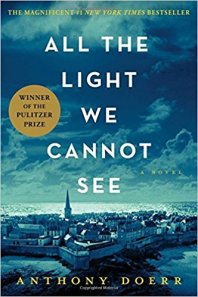
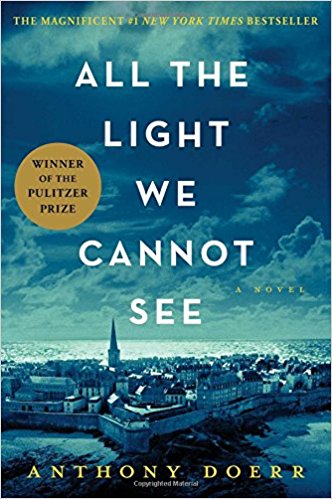
All the Light We Cannot See by Anthony Doerr

51wG7x-S+0L._SX330_BO1,204,203,200_

Synopsis

Set during World War II, the book tells the parallel stories of two children, Werner Pfennig and Marie-Laure LeBlanc. Werner is a clever German boy who is bit of genius when it comes to radio engineering and Marie-Laure is a blind French girl in possession of a valuable jewel. Over 200 chapters we witness their lives before the war, the onset of war, what part they took during the war, how their lives finally connect and events after the war. It is a tale of survival, morals and ultimately love. It’s worth noting that it took American author Anthony Doerr 10 years to write this historical novel.

My Quick Review

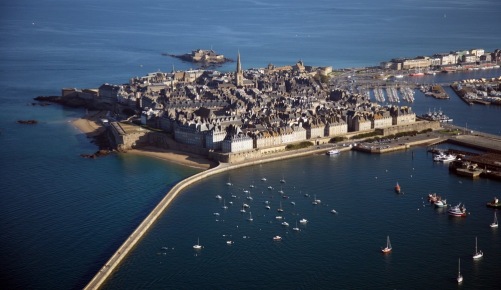
All the Light We Cannot See is so beautifully written it actually incites jealousy. I cannot help, but feel envious of the fact that I would never be able to write as well as this. The way Doerr describes scenes is so vivid, the reader has no problem with imagining them. In particular his description of Saint Malo, the house that Marie-Laure lived in and the bombing that took place there, sticks in my mind.

It was very interesting how the books depicts two different families torn apart by war for different reasons. So often books set during wars, tell the story from an adult’s perspective, so it was refreshing seeing how war affected children from both sides.

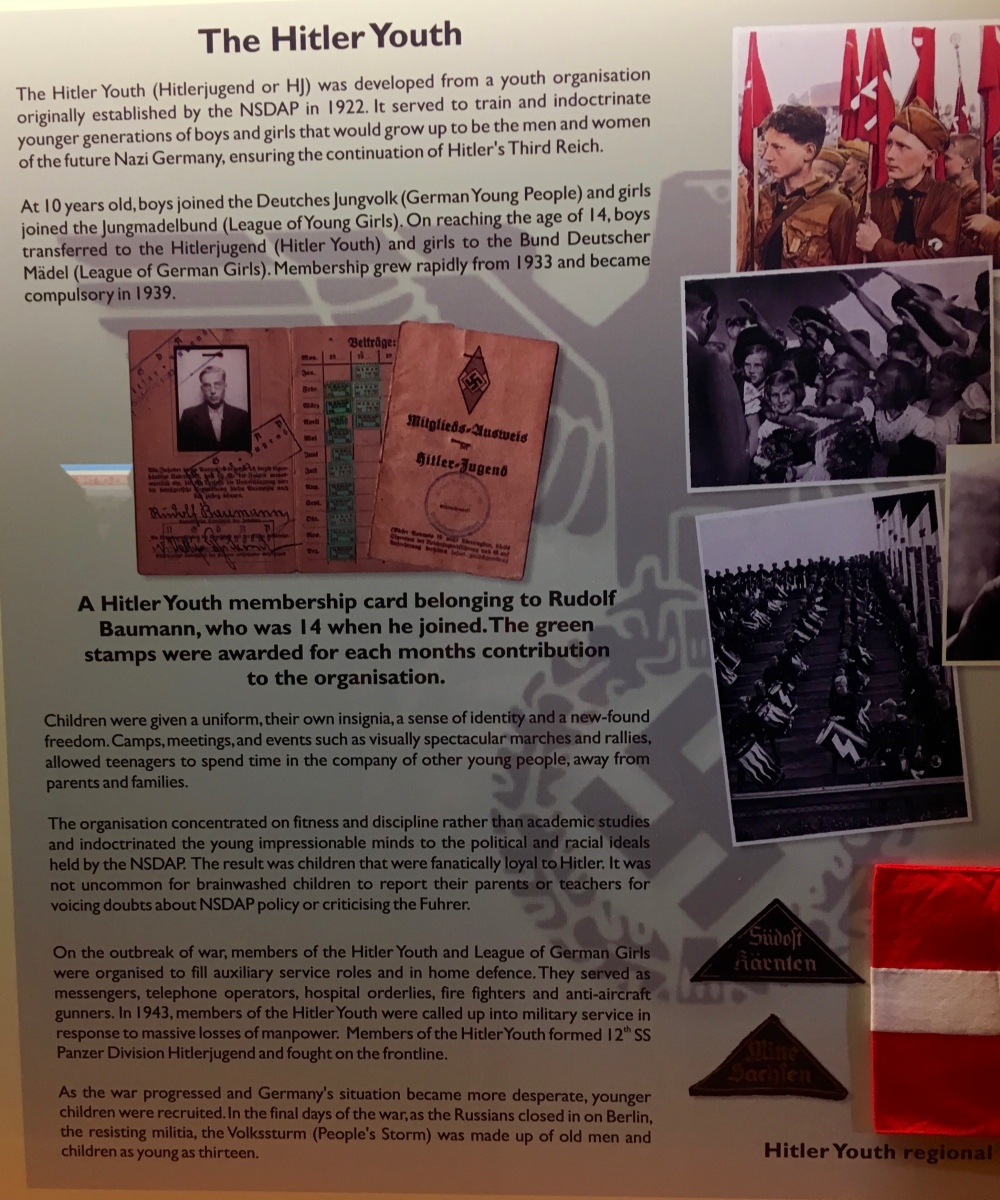
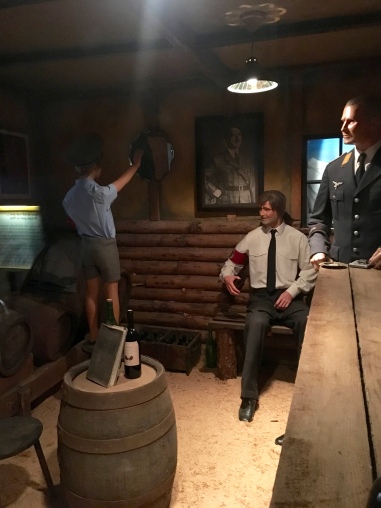
I recently visited Eden Camp, a Second World War museum inside an actual old prisoner of war camp, in North Yorkshire. It had a whole section on Hitler’s Youth, so I took a couple of (not very good photos) for you all.

IMG_7052

Information on the Hitler Youth

IMG_7055

A member of the Hitler Youth saluting a picture of Hitler

The book is made up of very short chapters. This gives the feel of a fast moving book that keeps you interested and makes you keep on turning the pages.

I can’t decide if I’m satisfied with the ending or not. Werner dies, Marie-Laure never finds her Father and the jewel is lost. However, I also feel this is a reflection on the reality of war. There are obviously so many unhappy endings in war and at least Marie-Laure continues on with a happy life.

Lastly, I want to mention the title of the book. Initially, it would seem to refer to two different things in relation to the two main characters. The more obvious one being Marie-Laure who is blind, whose other senses are heightened because of this. It also could be said that it might refer to the radio waves that we cannot see, but bring much light. This is a reference more so of Werner. However, I think the title also has a third reference, in that during something as hideous as a war, there is still much light. It may not be as obvious and would not dominate the discourse surrounding war as much, but nevertheless it is there. Do you have any other thoughts regarding the title?

As much as I loved this book, the story and the writing, I probably wouldn’t call it a masterpiece as many people are.

Whilst reading it, I could clearly imagine and predict this book will be turned into a film. I can’t see any evidence of it happening yet, but there certainly are rumours.

oU4jkTB5gb4o8fpZhQXyAfzj

Saint Malo today

Questions to Consider

You don’t have to answer these questions in your comments, but they might help to get you thinking about the book or to kickstart the discourse. 

1. The book opens with two epigraphs. How do these quotes set the scene for the rest of the book? Discuss how the radio plays a major part in the story and the time period. How do you think the impact of the radio back then compares with the impact of the Internet on today’s society?

2. The narration moves back and forth both in time and between different characters. How did this affect your reading experience? How do you think the experience would have been different if the story had been told entirely in chronological order?

3. Whose story did you enjoy the most? Was there any character you wanted more insight into?

4. When Werner and Jutta first hear the Frenchman on the radio, he concludes his broadcast by saying “Open your eyes and see what you can with them before they close forever” (pages 48–49), and Werner recalls these words throughout the book (pages 86, 264, and 409). How do you think this phrase relates to the overall message of the story? How does it relate to Madame Manec’s question: “Don’t you want to be alive before you die?” (page 270)?

5. On page 160, Marie-Laure realizes “This . . . is the basis of his fear, all fear. That a light you are powerless to stop will turn on you and usher a bullet to its mark.” How does this image constitute the most general basis of all fear? Do you agree?

6. Reread Madame Manec’s boiling frog analogy on page 284. Etienne later asks Marie-Laure, “Who was supposed to be the frog? Her? Or the Germans?” (page 328) Who did you think Madame Manec meant? Could it have been someone other than herself or the Germans? What does it say about Etienne that he doesn’t consider himself to be the frog?

7. On page 368, Werner thinks, “That is how things are . . . with everybody in this unit, in this army, in this world, they do as they’re told, they get scared, they move about with only themselves in mind. Name me someone who does not.” But in fact many of the characters show great courage and selflessness throughout the story in some way, big or small. Talk about the different ways they put themselves at risk in order to do what they think is right. What do you think were some shining moments? Who did you admire most?

8. On page 390, the author writes, “To shut your eyes is to guess nothing of blindness.” What did you learn or realize about blindness through Marie-Laure’s perspective? Do you think her being blind gave her any advantages?

9. One of Werner’s bravest moments is when he confronts von Rumpel: “All your life you wait, and then it finally comes, and are you ready?” (page 465) Have you ever had a moment like that? Were you ready? What would you say that moment is for some of the other characters?

10. Why do you think Marie-Laure gave Werner the little iron key? Why might Werner have gone back for the wooden house but left the Sea of Flames?

11. Von Rumpel seemed to believe in the power of the Sea of Flames, but was it truly a supernatural object or was it merely a gemstone at the center of coincidence? Do you think it brought any protection to Marie-Laure and/or bad luck to those she loved?

12. When Werner and Marie-Laure discuss the unknown fate of Captain Nemo at the end of Twenty Thousand Leagues Under the Sea, Marie-Laure suggests the open-endedness is intentional and meant to make us wonder (page 472). Are there any unanswered questions from this story that you think are meant to make us wonder?

13. The 1970s image of Jutta is one of a woman deeply guilt-ridden and self-conscious about her identity as a German. Why do you think she feels so much guilt over the crimes of others? Can you relate to this? Do you think she should feel any shame about her identity?

14. What do you think of the author’s decision to flash forward at the end of the book? Did you like getting a peek into the future of some of these characters? Did anything surprise you?

15. Aleksandr Solzhenitsyn once wrote that “the line dividing good and evil cuts through the heart of every human being.” All the Light We Cannot See is filled with examples of human nature at its best and worst. Discuss the themes of good versus evil throughout the story. How do they drive each other? What do you think are the ultimate lessons that these characters and the resolution of their stories teach us?

Just a reminder that August’s book is “Hotel Alpha” by Mark Watson. I’ll be starting the conversation for that on Monday 4th September.

For a list of all the other books we’ll be reading this year, please click here

Just Another Book Club- 2017

Books-IFOA-2016-Tanja-Tiziana

***For the list of books we’re reading for the first half of 2018 click here ***

Yes, my beautiful friends, I have set up a book club on these here pages for anyone to join in with this book worming fun.

I’m finding more and more often these days, that I’m reaching for my smartphone to entertain me rather than a book. Reading used to be my favourite pastime, but now it seems to be doing ‘If you were a cheese, which would you be?’ type quizzes. FFS (I’d clearly be Wensleydale & Cranberry btw) or looking at slideshows of celebrities who remarkably look a bit older, now that they are -you know- older.

So, I’ve started this book club as a way to motivate me to get back to my regular reading habits and I’d love you to join me.

Here’s how it will work.

  1. I will provide a list of 6 books, one for each month for the rest of the year.
  2. At the end of each month (or beginning of the following one, depending on how organised I’m being), I’ll pop a quick post giving my thoughts on the book.
  3. Your lovely selves can then provide your thoughts/opinions within the comments section and a discussion can evolve from there.
  4. Obviously, there’s no obligation. You can read all six, only three or just the one. Whatever suits you best or how much you want to join in.
  5. You can join in the discussion whenever you want, but the closer to the time I published my book review post the better, as you’re more likely to get a response from other readers.
  6. If this is a success, I’ll list 6 more books at the end of the year for the first half of 2018.
  7. Drinking wine/gin/tea/coffee isn’t obligatory whilst joining in with the discussion about these books, but it might help.
  8. Any questions, let me know.

Okay, so now for the 6 books for the rest of this year.

July: All the Light We Cannot See by Anthony Doerr (as you’re not seeing this in advance of July, I won’t publish the review post until 7th Aug. The next book will be a shorter one)

51wG7x-S+0L._SX330_BO1,204,203,200_

August: Hotel Alpha by Mark Watson

51wYJqtbPKL

September: Irresistible: why you are addicted to technology and how to set yourself free by Adam Alter (I thought this would be appropriate as we’re trying to smartphone less/read more).

cover


October: A Million Little Pieces by James Frey

51qh4Es5nmL._SX323_BO1,204,203,200_

November: Homegoing by Yaa Gyasi

30347641._UY200_

December: My Grandmother Sends Her Regards and Apologises by Fredrik Backman

9781444775853

The chosen list of books is final. If you don’t fancy reading a particular book one month, just give it a miss that month. If I carry on with this into 2018, I’ll select the odd old classic book too. I’ll always provide at least one non-fiction book within a list.

Lastly, I just want to thank the lovely Angela at You Are Awesome blog for providing me with the inspiration to set this up. Check out her blog post here about book clubs.

So, join me! Together we can put our phones down and pick up a book. Do me a favour first though and holler below in the comments (or within the comments of my Facebook page) if you fancy joining my book club. Also, please spread the word. It will be fantastic to get people from across the globe coming together to discuss a mutual love- books.

292553

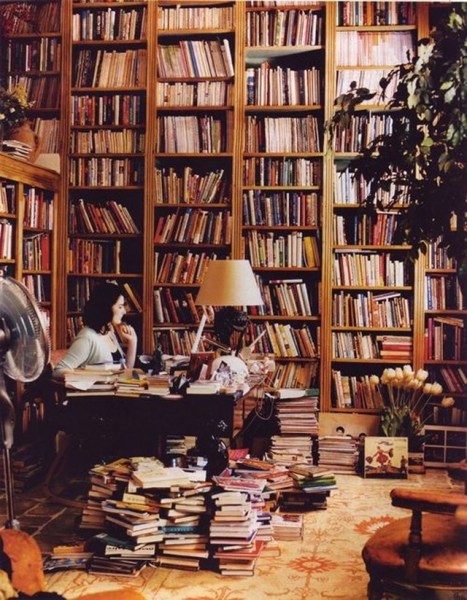
Nigella Lawson in her library. Further proof that I should actually be her.